£79.95
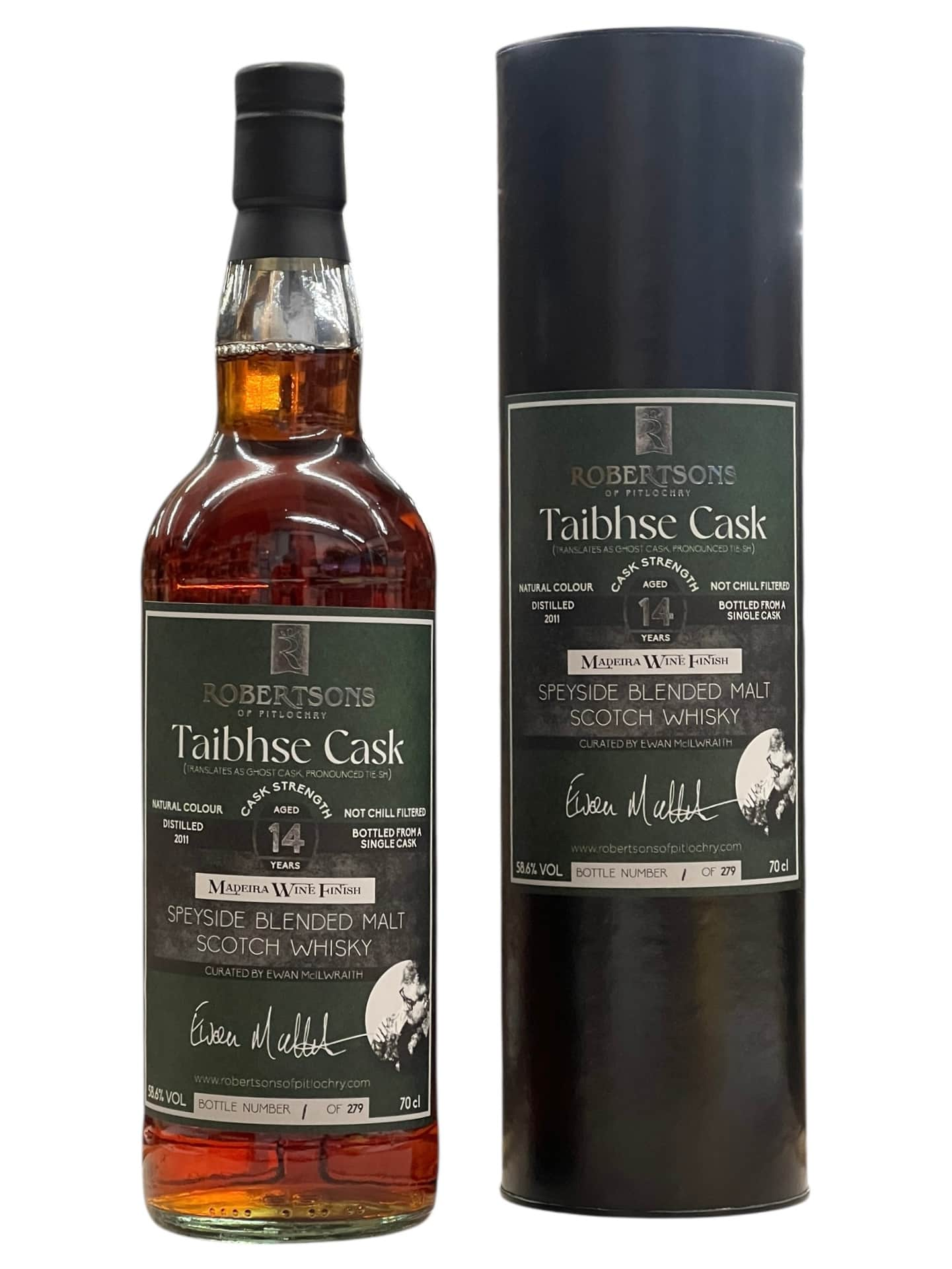
NEW RELEASE FROM ROBERTSONS OF PITLOCHRY Speyside Blended Malt 14yo Madeira Finish 58.6% abv An incredible 14yo peated ‘tea spooned’ dram from Speyside. What does that mean? A teaspoon dram is one that has had the smallest amount of a second whisky added to it so that it cannot legally be referred to by the distillery name or as a Single Malt. This one it is 99.9% and 0.1%. I can’t name the majority distillery other than to say it is near the ‘Hill of Riach’. In essence it is a blended malt but with not the usual 90%/10% blend you would expect. This is bottled from a single cask with just 279 bottles. Natural colour and non-chill filtered ensures you get the best quality and flavour possible! Nose: Sweet peat, beach bonfire, toasted marshmallows, vanilla and fresh croissants, lots of wood notes and toffee apples on sticks. Taste: White pepper, warm spices, peat fires, rich mouth feel with developing hot spices and rolling peat smoke. Hazelnuts and peaches, roasted coffee, toffee, chocolate and dried fruits. Finish: Long, hot and peppery.
Speyside Blended Malt 14yo Madeira Finish 58.6% abv
‘The best laid schemes o’mice and men gang aft a-gley’
Robert Burns could well have been writing about John Duff [builder of Glenlossie and Longmorn] and his intention to establish a whisky-making fiefdom close to Elgin. His Longmorn distillery had been built in 1893, and having achieved early success he decided what was needed was another plant next door. In 1897, he built ********. Sadly, his timing could not have been worse.
The Pattison crash of 1899, coupled with a downturn in the domestic market, saw a huge number of distilleries (many of which had only just opened) close down. ******** was once of those, only running for two years before languishing in silence for the next 65, during which its large malting facility was used to supply Longmorn’s requirements.
The upturn in whisky’s fortunes in the 1960s saw ******** run from 1965 onwards. A single malt was bottled in 1995 as part of then owner Seagram’s version of UDV’s Classic Malts, but volumes were limited and its reputation was not particularly high. As a result, most malt whisky drinkers dismissed it.
When Pernod Ricard took over Seagram’s whisky division in 2001 ******** was closed once again, but bought in 2003 by Billy Walker, the former production director of Burn Stewart, and two South African entrepreneurs (an ironic echo of Duff’s attempts to establish whisky production in that country in the late 19th century). The BenRiach Distilling Co. now owns Benriach itself, Glendronach (where, incidentally, John Duff was once manager) and Glenglassaugh.
As a former blender, Billy Walker had insight into the true quality of ********. A selective series of bottlings, mixing old (from Seagram days), very young (from their ownership) and peated (from both) proved an eye-opener to malt drinkers. It has rapidly become a strong performer on the global market. Today it is back in full production and in 2013 the floor maltings reopened.
The distillery was picked up by Brown-Forman, one of the largest US wine and spirits producers, in 2016 along with the Louisville-based company’s acquisition of the entire ******** Company.
| Weight | 1.5 kg |
|---|---|
| Dimensions | 14 × 40 × 14 cm |